
Did you know that it's possible to search for documents from several different places within the platform? This article will explain how to find documents from within "Documents".
This article includes:
- How to search for contracts with filters?
- Tips for using filters:
How to search for contracts with filters?
Start by going to the "Documents" section and adding a filter under +Add filter.
.png?width=400&height=486&name=Filters%20(1).png)
You can search for documents using various filters:
-
Status: Draft, In signing, Completed, Awaiting finalisation or Cancelled.
-
Document creation date: When the document was created.
-
Document title
-
Contract date: The date when the contract was created.
- Contract updated at
- Contract start date (Drive+ filter)
-
Contract end date (Drive+ filter)
-
Signing date: When the document was signed.
- Owner: Typically the person who created the document, unless the Owner field has been changed afterwards.
-
Document type: What category the document belongs to.
-
Tags: What tags have been added to the document. (Drive+ filter)
-
Party: The parties to the document, i.e. the signatories.
- Retention end date (Drive+ filter)
-
Personal information: Whether the document contains personal data or not (Drive+ filter)
Tips for using filters:
There are a few things that are good to know when using filters. These can help you simplify and improve your contract management.
1) You can use multiple filters at the same time.
You can use multiple filters to narrow down your search based on various criteria, which significantly simplifies the process. For example, if you want to find documents that are at the signing stage and were created by a specific person after a certain date, you can do this using three filters.
.png?width=670&height=207&name=Filters%20(2).png)
2) Include subfolders -button
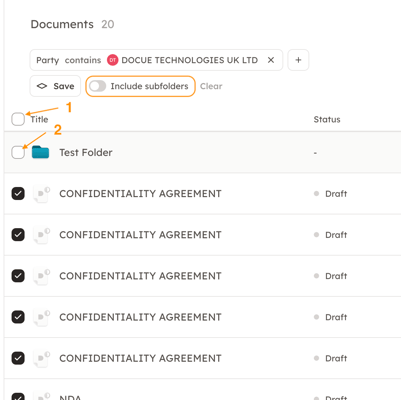
Depending on your search, you may want to toggle the Include subfolders option. Leaving this unselected restricts the filter to the main folder only.
This is a useful strategy if, for example, you want to find specific files in the root folder and move them into a subfolder without cluttering your search results.
.png?width=670&height=327&name=Filters%20(3).png)
3) You can select multiple documents at the same time
There is the possibility to select several documents at the same time. The multi-select tool is definitely worth using in cases where you have several documents that meet the necessary conditions and you need to either delete them or move them to a new folder.
An example: You need to move all the documents with the same party to a new folder.
a) Start by filtering out the document containing that party by using the filter "Party".
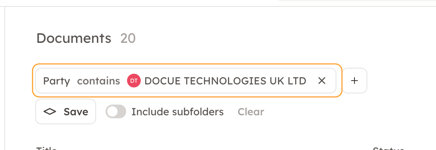
b) Once you have filtered the documents, click on the box next to "Title". This will select all the documents. Keep in mind, that if you have not included subfolders to the search, selecting all will also include all folders. So be sure to deselect them if you don't want to move those to the same folder.
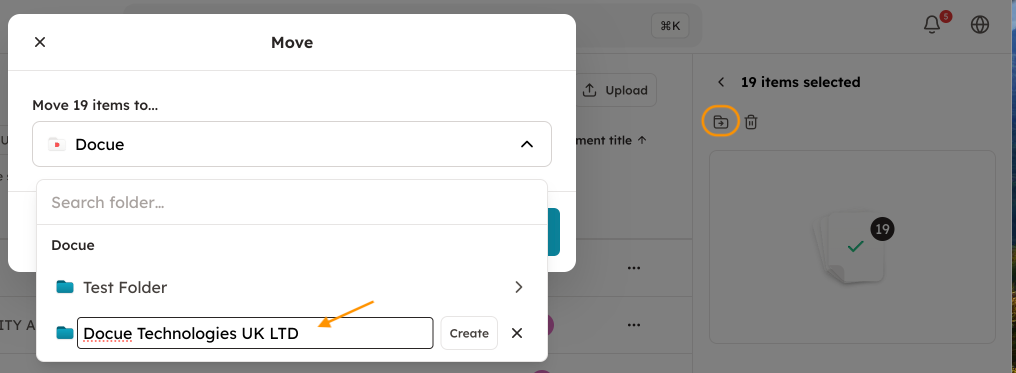
c) Then you can move all the selected documents to a new folder which you can create using the name of the party.
Consider exploring other parts of the platform to discover documents that may not be immediately visible within the primary "Documents" tab. "Recent" section allows you to view the most recently created documents and the "Views" section allows you to view documents with the views you have created (Drive + feature).
Key words: search, find, document